Planning a wedding means bringing a dream to life, but also making decisions, setting priorities and carefully allocating available resources. Your wedding budget is not simply a figure to stick to: it is the starting point for creating an experience that truly reflects who you are.
At Tenuta La Valle, planning your special day also means learning to recognise the value of every choice: from the venue and the spaces you will enjoy, to the welcome you offer your guests and the moments you share around the table. A well-allocated budget is not just about keeping costs under control; it is about investing in what makes your wedding truly unique.
When you first start planning a wedding, sooner or later a question arises that may seem simple but lies at the heart of one of the most important decisions you will make throughout the process: how should you allocate your wedding budget?
Before choosing the flowers, imagining the menu or falling in love with a particular venue, it is essential to have a clear idea of how much you want to invest and, above all, what kind of experience you want to create.
Your wedding budget should not be just a list of figures to add up and subtract. It is not simply a matter of percentages, quotations and expenses: it is a planning tool that helps you establish priorities, make informed decisions and, above all, prevent the wedding planning process from turning into a constant search for ways to save money.
The first step, therefore, is not to ask, “How much does a wedding cost?”, but rather: “What do we want our guests to remember about this day? What is truly worth investing in?”
This changes the entire perspective.
A well-planned wedding is not necessarily one with the largest budget, but one in which the available resources are allocated in a way that reflects the couple’s vision.
Saving on one item may be a sensible decision, while cutting costs on a fundamental element of the event can lead to a chain reaction of problems, compromises and unexpected expenses.
In short, your budget is not there to put limits on your wedding: it is there to give it direction.
The lowest quote trap: why cost is never the only factor
When searching for suppliers, there is a common pitfall that is easy to fall into: choosing a proposal simply because it comes with the lowest price.
At first glance, it may seem like the most cost-effective decision. After all, if two professionals appear to offer the same service at very different prices, why not choose the cheaper one?
The key word is appear. In the events industry, two quotations are not necessarily comparable simply because they list the same service. Behind the figures, there may be significant differences in experience, organisation, materials, staffing, support and the ability to deal with unforeseen circumstances.
For example, a particularly low-priced offer may exclude certain services that will be added later, or include different materials and staffing from a more comprehensive proposal.
What initially looks like a saving can turn into a series of additional costs or difficult compromises as the wedding day approaches.
For this reason, when planning your wedding budget, price should be just one of the factors you consider.
The more important question is: what does that price actually include, and what value does it bring to your wedding plans?
Choosing a professional for your wedding means assessing the strength of their proposal, their experience, their organisational skills and the level of attention they will be able to dedicate to your event.
An experienced, well-established professional offers more than just a service: they bring a methodical approach, expertise and the ability to manage the event effectively. Above all, they help protect your plans from the unforeseen circumstances that, when it comes to a complex event such as a wedding, can have a much greater impact on the final cost than expected.
Often, the real saving does not come from choosing the lowest price, but from avoiding the cost of putting things right a second time after making a decision without having all the necessary information.
The role of Banqueting & Catering: creating a shared experience
Among the main components of a wedding budget, catering generally accounts for a significant proportion of the total, and it is not difficult to understand why.
Food and drink are not simply services to include on a list of expenses: they are among the central moments of the day, when guests sit together, talk, raise a glass and share time and emotions.
Banqueting therefore plays a direct role in shaping the overall experience of the event.
When assessing a catering or banqueting service, the number of courses should not be the only factor guiding your decision.
Other elements matter, including:
- The quality of the ingredients
- The way the menu is designed
- The punctuality of the service
- The professionalism and preparation of the waiting staff
- The ability to accommodate different dietary requirements without compromising the experience of any guest
Timing is equally important.
A wedding is a sequence of moments that should flow naturally from one to the next: the drinks reception, dinner, toasts, speeches, cake cutting and celebrations. When everything runs smoothly, guests are unaware of the organisation behind the scenes. They simply enjoy a pleasant, seamless day without interruptions.
This is the real strength of well-organised banqueting: its ability to become almost invisible.
Guests should remember the pleasure of spending time together, an especially memorable dish, a toast beneath the stars or a relaxed dinner that was never rushed — not the waits between courses.
When setting your wedding budget, therefore, the question is not simply how much to spend on the menu, but what kind of culinary and shared dining experience you want to offer your guests.
The wedding venue: the backbone of the entire project
If catering takes care of the food and the other suppliers help create the atmosphere, the wedding venue provides the foundation for the entire event.
It is a choice that influences many of the decisions that follow: from logistics and catering to decorations, the use of the spaces and the possibility of hosting different parts of the day in the right setting.
For this reason, a venue should not be chosen solely for the visual impact of a room, a view or a particularly striking photograph.
The question to ask is broader: can this venue genuinely accommodate the wedding we have in mind?
A venue suited to hosting a multi-faceted event must meet specific operational and organisational requirements.
Flexible, independent spaces
Having distinct, well-defined spaces makes it possible to create a dynamic day, guiding guests naturally from one moment to the next without requiring them to spend the entire event in the same place.
The welcome, drinks reception, wedding reception, more intimate moments and celebrations can each have their own setting, creating a natural rhythm throughout the experience.
A reliable Plan B
When it comes to weddings, the weather cannot be left entirely to chance.
A genuine Plan B should not simply be an emergency space to use if it rains. It should guarantee the same quality of experience, with capacity, comfort and atmosphere that remain consistent with the original plans.
This is particularly important when setting your budget. Having a well-planned alternative in place helps avoid rushed decisions, last-minute costs and changes that could compromise the day.
Logistics and coordination
There are also all those practical considerations that may not appear in photographs but make a real difference on the wedding day.
Easy access for suppliers, dedicated technical areas for kitchens and decorations, the ability to organise service flows efficiently, and the availability of accommodation nearby or on site for guests travelling from further afield all contribute to the success of the event.
These details may be less visible, but they are essential.
That is why investing in the right venue means much more than choosing a beautiful backdrop for photographs. It means securing the foundation on which the rest of your wedding budget can safely rest.
Wedding budget: planning with confidence
Allocating your wedding budget wisely does not mean dividing a sum into lots of little boxes and trying to stay within them at all costs.
It means understanding your priorities, identifying the elements that genuinely shape your guests’ experience and recognising which choices can be scaled back without losing sight of the overall vision.
A good budget should also leave room for things that cannot be anticipated in every last detail. That is why it is important not to commit every available pound before the plans have been fully developed.
Having a financial buffer means you can deal more calmly with the small changes that inevitably arise during the planning process: an extra detail, a last-minute requirement or a decision that evolves along the way.
A well-allocated budget is not about imposing limits; it is about giving your choices direction and protecting them.
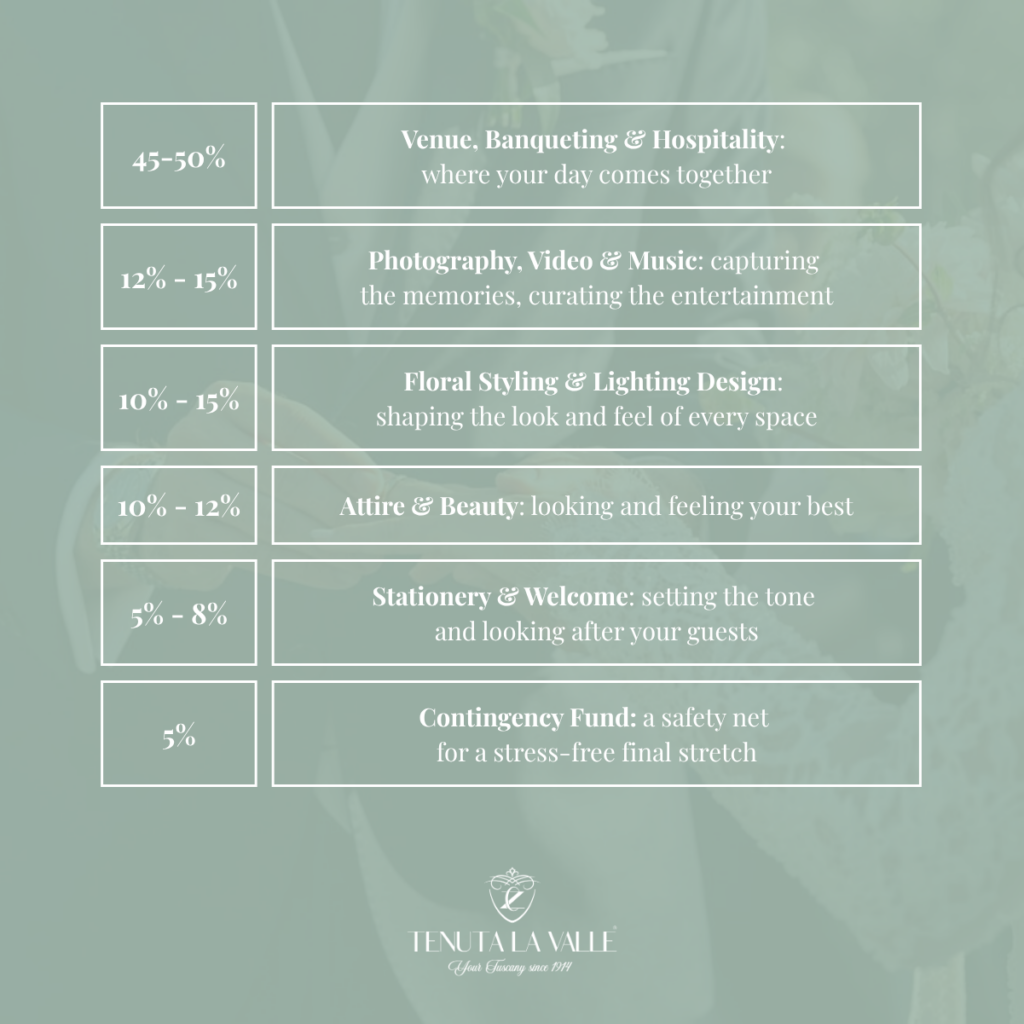
Working with qualified suppliers, carefully checking what is actually included in each quotation and choosing a venue capable of accommodating every aspect of the event means turning a simple sum of expenses into a cohesive plan.
The value of a wedding is not measured solely by how much you have spent, but by how well each choice has reflected who you are, how at ease you have felt throughout the planning process and how, by the end of the day, everything has simply felt right.
The budget is the starting point. The experience you create together is the real achievement.